ConvertInAR Blog
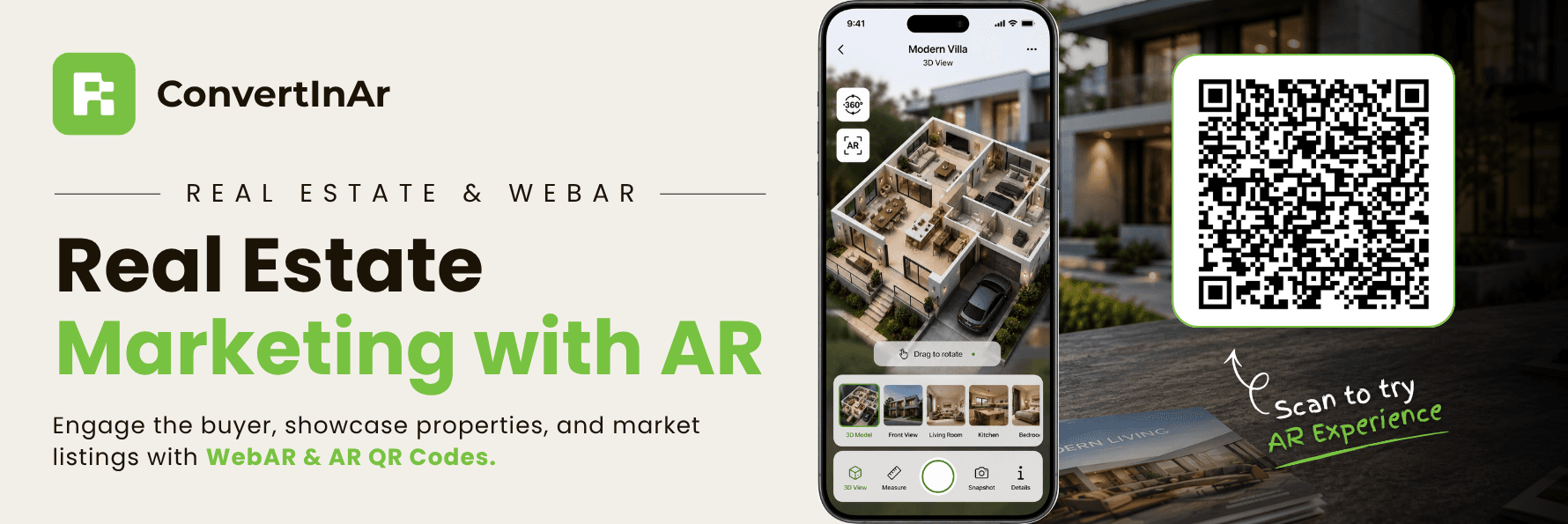
Real Estate Marketing with Augmented Reality
The real estate industry has embraced digital marketing over the past decade, but many property listings still rely on photos, videos, and floor plans to attract buyers. While these assets provide useful information, they often fail to give potential buyers a true sense of a property's layout and features.
Augmented Reality (AR) is changing that. By combining interactive 3D models with WebAR and AR QR Codes, real estate professionals can create engaging property experiences that help buyers explore listings from anywhere using their mobile browser without downloading an app.
Whether you're a real estate agency, property developer, or independent realtor, Augmented Reality can help make your marketing more interactive, memorable, and informative.
What Is Augmented Reality in Real Estate Marketing?
Augmented Reality enhances the real world by displaying digital content through a smartphone or tablet camera. In real estate marketing, AR allows buyers to interact with digital property models and visual content in a way that traditional images cannot provide.
Instead of scrolling through a gallery of static photos, potential buyers can launch an interactive property experience that helps them better understand a home's design, layout, and key features.
This creates a more engaging property discovery process and keeps buyers interested for longer.
Why Interactive Property Experiences Matter
Buying a home is one of the biggest financial decisions most people make. Before scheduling a viewing, buyers want as much information as possible.
Common questions include:
- What does the property look like from different angles?
- How is the space organized?
- What are the standout design features?
- Does the property match the online listing?
Interactive 3D experiences provide additional context that helps answer these questions and gives buyers greater confidence before taking the next step.
AI Simplifies Property Visualization
Creating digital property assets has become more accessible thanks to artificial intelligence.
An AI Image to 3D Model Generator can transform property images into interactive 3D models that are easier for buyers to explore online.
Similarly, an AI Text to 3D Model Generator can help visualize property concepts from written descriptions during the planning or development phase.
These AI-powered tools make it easier for real estate businesses to create engaging marketing content without complex production workflows.
How WebAR Improves Real Estate Marketing
One of the biggest advantages of modern AR experiences is accessibility.
With WebAR, buyers can access interactive property content directly through their mobile browser. There is no need to install a dedicated application, reducing friction and making it easier for more people to engage with listings.
This convenience helps real estate professionals reach a wider audience across different marketing channels.
AR QR Codes Connect Offline and Online Marketing
Real estate marketing often includes both digital and printed materials.
AR QR Codes make it easy to connect these experiences.
They can be added to:
- Property brochures
- Sale boards
- Newspaper advertisements
- Business cards
- Property flyers
- Exhibition displays
- Open house materials
After scanning the QR code, buyers can instantly access an interactive property experience from their smartphone.
This transforms traditional marketing materials into engaging digital experiences.
WebAR Supports Multiple Marketing Channels
Real estate professionals can integrate WebAR into various customer touchpoints, including:
- Property listing websites
- Social media campaigns
- Email marketing
- Digital advertisements
- Property exhibitions
- Sales presentations
Because experiences launch directly in the browser, buyers can begin exploring properties immediately without additional steps.
Practical Ways Real Estate Professionals Use Augmented Reality
AR can support buyers throughout the property search process while helping agencies present listings more effectively.
Showcase New Property Developments
Developers often begin marketing projects before construction is complete.
Interactive 3D property experiences help potential buyers better understand planned developments and visualize future properties.
This creates stronger engagement during pre-launch marketing campaigns.
Present Luxury Properties More Effectively
Luxury homes often feature premium architecture, custom interiors, and unique design elements.
Interactive 3D experiences allow buyers to closely inspect these details, offering a richer viewing experience than traditional image galleries.
Enhance Property Marketing Campaigns
AR QR Codes can be included across both online and offline campaigns to encourage buyers to continue exploring listings.
Examples include:
- Printed brochures
- Real estate magazines
- Outdoor billboards
- Property signage
- Developer events
These interactive experiences help marketing materials stand out while encouraging longer buyer engagement.
Best Practices for Using Augmented Reality in Real Estate
To maximize the value of AR, focus on creating experiences that are simple, informative, and easy to access.
Consider these best practices:
- Create high-quality 3D property models.
- Use WebAR so buyers can access experiences instantly.
- Place AR QR Codes on both printed and digital materials.
- Highlight important property features through interactive content.
- Optimize experiences for mobile devices.
- Include clear instructions for first-time users.
The objective is to make property exploration easier while helping buyers make more informed decisions.
Which Properties Benefit Most from AR?
While AR can enhance many property types, it is especially valuable for listings where visualization plays an important role.
Examples include:
- Luxury homes
- Apartments
- New housing developments
- Commercial properties
- Office spaces
- Retail units
- Vacation homes
- Display homes
These property types often benefit from interactive presentations that help buyers better understand the available space and design.
The Future of Real Estate Marketing Is Interactive
As buyer expectations continue to evolve, real estate businesses need marketing strategies that provide more than static content.
Interactive 3D models, WebAR, and AR QR Codes offer a practical way to make property marketing more engaging while helping buyers gather information before arranging a viewing.
With AI making 3D model creation faster and more accessible, agencies of all sizes can begin adopting these technologies to improve their digital marketing efforts.
For modern real estate businesses, Augmented Reality is becoming an effective way to showcase properties and create better customer experiences.
Conclusion
Augmented Reality is transforming how properties are marketed by giving buyers a more interactive way to explore listings. Instead of relying only on images and videos, agencies can create immersive 3D experiences that are easy to access through a mobile browser.
With AI-powered 3D model generation, WebAR, and AR QR Codes, real estate professionals can enhance digital campaigns, improve buyer engagement, and create more informative property presentations.
If you're looking to make your real estate marketing more interactive, ConvertInAR helps you generate AI-powered 3D models, publish browser-based WebAR experiences, and share them instantly using AR QR Codes without requiring buyers to install an app.